
Here’s the truth that nobody with a Hellcat is willing to admit: you can’t use more than 450 horsepower on the street. Not without a good lawyer. Let me get this out of the way up front, this statement refers only to cars driven on the street. There’s never too much horsepower on a race track. Everyone knows that. Moving on…
Chasing horsepower is a stage of every enthusiast’s journey. Some never grow out of that stage, in fact, most of us never do to a certain extent. Horsepower (realistically, torque) just feels cool, and it sounds cool too…usually (I’m looking at you EVs). But it’s undeniable that being pushed back into the seat (even in a Tesla) as you press the skinny pedal down is the most universally loved feeling among car enthusiasts. On the street though, there is a limit. And that limit is 450 horsepower… in a normal 3,000-4,000 lb. car that is.
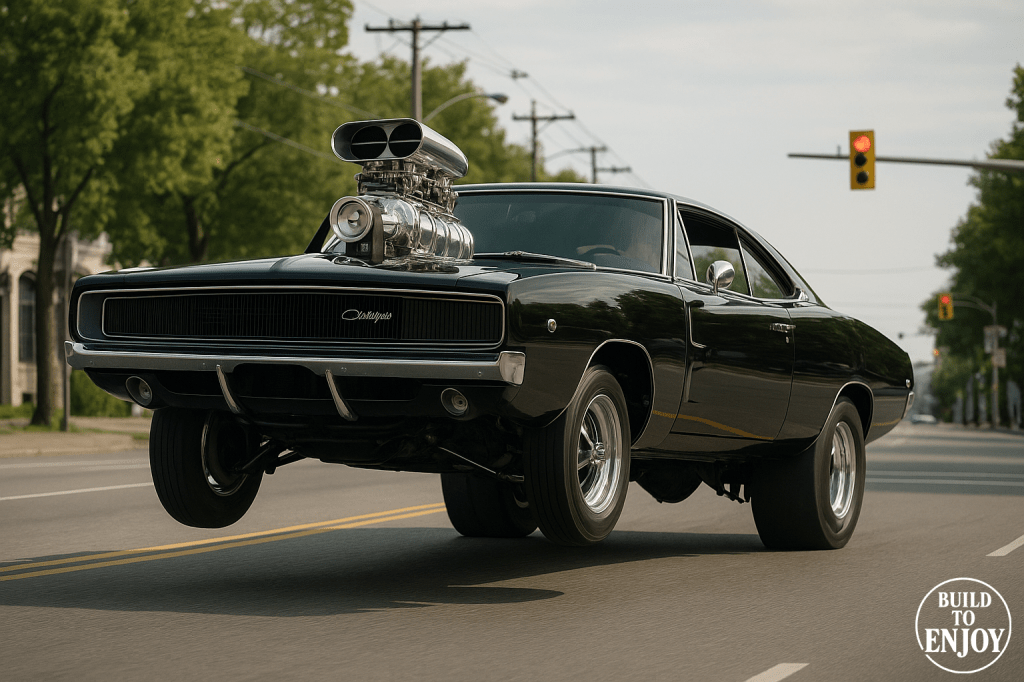
The Things That Actually Matter
Let’s nerd out for a second. What really makes a car quick, or feel quick is not horsepower alone. It is much more complicated than that. There are a number of factors that go into making a car feel fast, and horsepower is merely the last piece of the puzzle.
Torque
Horsepower is what makes the needle on your speedometer move quickly, but torque is what you’re actually feeling when you get pushed back into the seat. Torque creates the drama, and the drama is what makes us feel alive. If you ever get the chance, drive or get a ride in a regular non-Z06 C6 Corvette and an E92 M3 back to back. They both have just over 400 horsepower but greatly different torque numbers. The C6 Corvette has 400 lb. ft. of torque while the E92 M3 has just 295 lb. ft. of torque. The difference you would feel from 100 lb. ft. of torque difference will shock you. The C6 Corvette is going to feel a lot more dramatic and “fast” than the E92 M3.
Traction
Perhaps the biggest factor in a car feeling fast on the street is traction. Without it, you’re quite literally not going anywhere. Traction is perhaps the most complicated factor as well. Power delivery, tire choice, tire pressure, tire size, tire age and condition, suspension geometry, spring rate, drivetrain configuration, weight balance, surface conditions, and driver skill are all big factors in getting traction. And traction is what makes horsepower and torque actually usable. Making horsepower is the easy part. Making it usable is where people struggle. Talk to any drag racer and they’ll tell you that they spend the entire race weekend chasing traction, not horsepower.
Power To Weight Ratio
Power to weight ratio is really the only number that matters, and in my fantasy alternate reality, that is the number all car guys discuss at Cars & Coffee. Power to weight ratio is a simple math equation that answers the question of how many pounds of weight does each horsepower have to push? The lower that ratio, the faster a car is, period.
A Dodge Challenger Hellcat has 717 horsepower and it weighs 4,400 lbs. Divide 4,400 by 717 and you get a power to weight ratio of 6:1, meaning for every 1 horsepower it carries 6 lbs. of weight. Going back to my C6 Corvette example, that car weighs 3,200 lbs. and would only have to make 533 horsepower to achieve the same 6:1 power to weight ratio as a Challenger Hellcat. On paper, they are equally fast in a straight line. In reality traction, aerodynamics, gearing, power delivery, and driver skill would all play a factor.
Unfortunately, when it comes weighing things, the world has different units of measurement, which makes it hard to have a universal standard. Take the Koenigsegg 1:1 for example. The entire reason that car was built, is to achieve a 1:1 power to weight ratio. Except it doesn’t have that if you’re American because we measure everything in bald eagles. It has 1,360 horsepower, but it weighs 3000 lbs., so in America it is the Koenigsegg 2.2:1. In the rest of the world, it has 1,360 horsepower and weighs 1,360 kg. giving it the 1:1 achievement.

Straight to Jail
The other part of my argument is that too much horsepower on the street, if you can get traction, is not fun unless you have a great lawyer and/or a death wish. In most states, going anywhere from 15-30 mph over the speed limit moves a speeding ticket from a misdemeanor into a criminal offense. Now, we all do it, and for the most part, police use personal judgment on whether or not you were putting yourself or others in direct danger to determine what speed they actually write you up for, but at 15-30 mph over the speed limit, the option is there for the officer to really ruin a good time. So if you have a car that has so much power that you can’t go through two gears without being in triple digits, then you’re taking an awful lot of risk for whatever reward you get out of it. It’s all fun and games until your car is impounded and you’re in jail sitting between a meth head and a sex offender.
Then there’s the safety angle. Kids, listen to your elder here. If there’s one thing I learned from a decade and a half of pro-am sports car racing, it is that the majority of the population does not actually know how to drive safely, even if they’re going the speed limit. You yourself are probably in the same boat, but even if you aren’t, and you’re a true professionally skilled driver with loads of experience, it still doesn’t make anyone you share the road with a good driver. There’s two main factors behind my argument here…
First and foremost, nobody sets their mirrors correctly, leading to huge blind spots. If you can see any part of your car in your mirrors, they aren’t set properly. Keep on pushing them out until you just lose sight of your rear fenders. There’s no point in seeing the side of your car in the mirror, it isn’t going anywhere, you don’t need to keep an eye on it.
Second, and the most alarming, is that people don’t look far enough ahead so they often react to things instead of anticipate them because they don’t see them coming. Look as far out to the horizon as you can, always. I promise, even though you aren’t looking directly in front of your hood, you are still seeing that area in your field of vision. Anything out of the ordinary will get your attention. The faster you’re going, the further ahead you need to be looking. If you’re going 100 mph you’re traveling 146 feet per second. That’s half a football field, or 10 car lengths per second. The closer you’re looking to the hood of the car, the less time you are giving yourself to recognize, react to, and stop your car from 100 mph before you hit something.
And third, people are zoned out while driving. Not actively paying attention most of the time. And their brains and their eyes are working, but they’re not anticipating anything out of the ordinary, like a Supra going 100 mph. They look in the mirror to change lanes, their mirrors are set incorrectly, they aren’t looking far enough behind them, and even if they see the Supra 20 car lengths behind them, their brain doesn’t automatically calculate the closing speed and you end up with a car going 60 mph obliviously changing into your lane. They weren’t expecting anyone to be going that fast, because it rarely happens to them on their daily commute. The safest thing you can do as a driver for other drivers is to be predictable, because that’s what they’re expecting.

Closing Argument
You can have all the horsepower you want. You can be the king of Cars & Coffee. But if your traction control light blinks more than your turn signal, then you’re doing it wrong…in my opinion. We all love horsepower, we all crave that feeling of being thrown back into the seat, the symphony of exploding fuel and spooling turbos, of screaming superchargers. I am not here to be a buzzkill, and I am not anti-speed. But for me, give me a car that I can put my foot to the floor in through two gear changes on a freeway on-ramp without crossing into criminal offense territory. Give me something I can enjoy the sound of at full tilt without putting my life in the hands of the other drivers on the road.
Nobody is going to talk about how much power your car makes at your funeral. Nobody at the hospital is going to care how many car lengths you gapped that Lamborghini by before you slammed into the back of a Prius because they didn’t see you 30 car lengths back going 150mph before changing into your lane. The pedestrian’s family you killed isn’t going to “understand” that their loved one is dead because you had to feel for the 100th time what 1000 horsepower feels like.
450 Horsepower, 3,200 lbs. A 7:1 power to weight ratio. That is the ideal maximum for a street car in my opinion. Enough to have a lot of fun with if you think there’s nobody around, and not enough to ruin your life if you’re wrong. Or go with even less power. In fact, the most fun daily driver I have ever had, and I am not ashamed to admit this, was a 2010 MINI Cooper S JCW with some basic power and handling mods that made probably around 240 horsepower and 2,700 lbs., an 11:1 power to weight ratio.
Stop chasing big horsepower. Chase usable horsepower, and not so much of it that it ruins the fun of being able to use it. I leave you with a list of just some of the incredible cars that come in above that 7:1 power to weight ratio, with room to modify should you choose.
Porsche 997 GT3 | 7.5:1
Corvette C6 Base | 7.5:1
Ferrari 360 Modena | 7.5:1
Porsche 996 Turbo | 8:1
Audi R8 V8 | 8:1
Nissan R35 GT-R | 8:1
Corvette C5 Z06 | 8:1
Ford Mustang GT350 | 8:1
BMW E92 M3 | 9:1
Aston Martin Vantage V8 | 9:1
Nissan R34 GT-R (Real numbers, not the under-rated ones) | 9.5:1
BMW E46 M3 | 10:1
Nissan 370Z | 10:1
Toyota Supra Turbo MK4 | 11:1
Honda/Acura NSX | 11:1
Honda S2000 | 12:1

 build to enjoy
Leave a comment