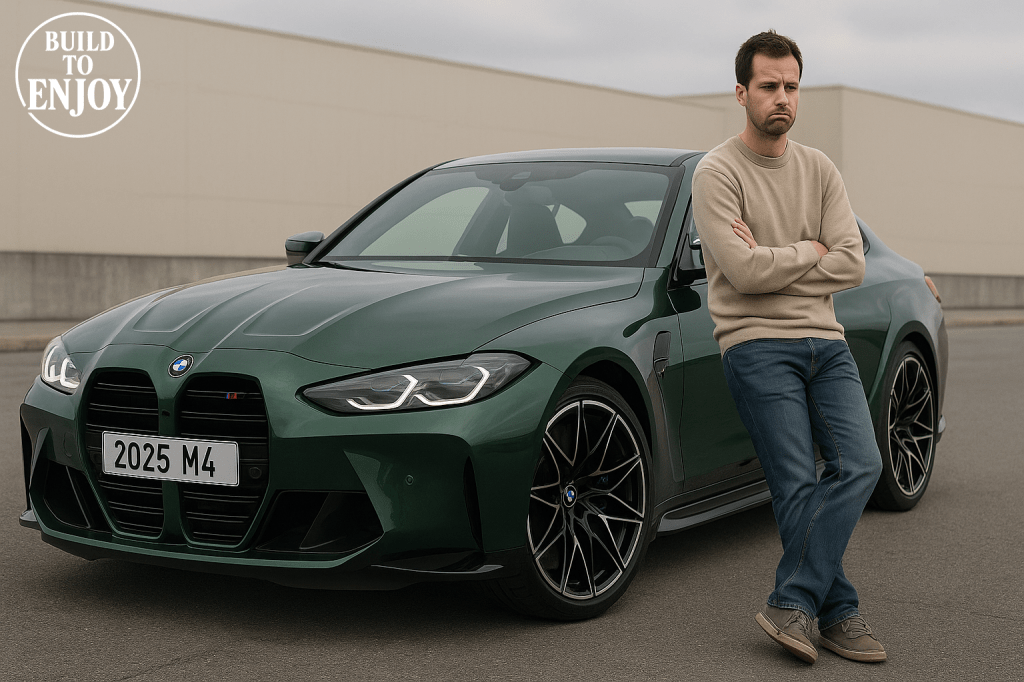
There, I said it. Of course there are some exceptionally good cars coming out today, but go ahead and make a list of truly exciting cars being made brand new today, see how many of them are actually attainable for most people. And before you start angry typing your comments, I am aware that there are tons of really good, really fast, cars. I am aware we’re in a horsepower war where you can get 700 horsepower station wagons. And while that may indeed be exciting to you, I am here to tell you that I have driven a handful of them, and they’re all boring. New cars have been boring the last 10 years. And here are the main reasons why…
Cars Are Too Big and Fat
I’m not here to body shame cars these days, it’s not their fault, but modern cars are just massive compared to what they used to be. Look at the lineage of the Porsche 911 side-by-side. Or the BMW M3. Icons of the sports car world. It’s across the board as well; the Corvette, the Ford Mustang, the Camaro, the Nissan Z, the list goes on. And it’s not just a dramatic increase in footprint or overall size, it’s weight too. Cars, over time have gotten significantly heavier as well. Classic American muscle cars used to get a bad wrap for being land yachts, huge, heavy, chunks of steel that wouldn’t even fit in a modern-day garage. Today’s sports cars though are just as heavy, with so many of them weighing in at 3,500+ lbs.
So why are we regressing? Well, it’s not the car’s fault, it’s the governments. And we all love blaming the government. Over time, safety regulations and crash standards have been the main driver for increased vehicle size. An overall good thing, yes, but larger crumple zones have spaced the bumpers out further and further from the cabin. Thicker door beams and stronger structural pillars add weight. Higher belt lines to protect better on side impacts add height and mass. EPA and fuel economy regulations have played their role as well. Forced induction and/or hybrid systems add a ton of weight but they allow for the use of smaller engines that get better fuel economy. Catalytic converters and complex emission control systems are all add-ons over the decades. But it’s not all the fault of government rules and regulations, some of it is our fault as well…
Changes in customer expectations and standards have also changed, namely in the technology and comfort department. Luxury materials like leather are heavier than cloth. Power everything, dual zone climate control, high-tech infotainment systems, 630 speaker sound systems, sound deadening and thicker glass, 7-10 speed automatic transmissions, etc. are things that we, as a population, expect in a modern vehicle. All of that tech requires wiring, and although it doesn’t seem like it, wiring is heavy.
Finally, now that the cars are heavier, the manufacturers also need to fit larger tires and brakes to handle the job. Those are heavier. Stiffer sway bars…heavier. Beefier suspension and subframes to handle the stress…heavier. Oh, and sports cars need to make a ton of power now too to offset the weight, so we’re talking forced induction and hybrid powertrains a lot of times.
I will be the first to admit that the manufacturers have done a magnificent job of balancing all of this and still making sports cars faster than ever, but no matter which way you slice it, they just don’t feel as nimble or sporty as their older counterparts. Because they aren’t. Physics are still a thing. But that’s not the worst part…
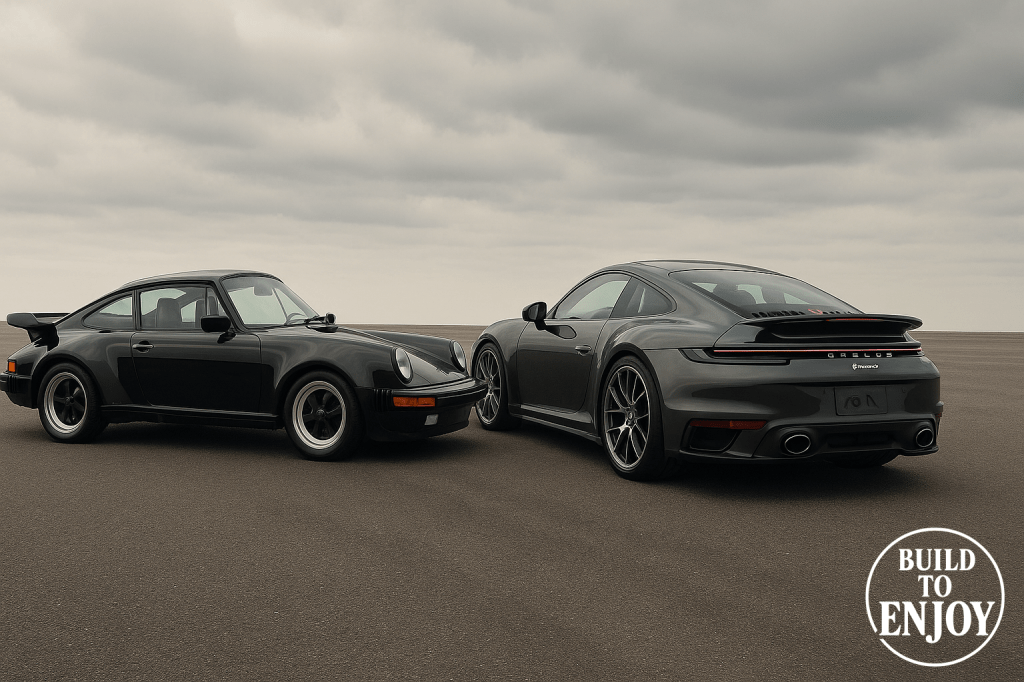
This image is created using AI.
Cars Have Lost Their Soul
For me, the biggest issue with modern sports cars, and really any modern car, is that they have lost their soul. In the relentless pursuit of performance, manufacturers have finally gotten to the point where they are fixing the single most unreliable, most variable, most difficult barrier for extracting performance out of their cars…the driver. Over the past decade and a half the driver has been more and more removed from the picture in terms of getting the car to perform at it’s peak. Translation; cars are driving themselves more and more, both literally and figuratively.
These days everything a driver used to feel from the vehicle is now being filtered through a series of sensors and electronics. In some cars there is literally no longer any mechanical connections between the driver’s inputs and the vehicles reactions. Electric power steering, electric throttle, electronic braking, electriconic differentials, electronic shifting, electronic EVERYTHING. These complex electronic systems take a driver’s input and combine that data with the data from 100 different sensors around the car to make its own decision on what’s best. The biggest problem with this from a driver’s perspective is actually the lack of feedback that the driver gets from the car’s tires. A crucial part of high performance driving. The result, a video-game like experience that is just…numb.
The Nissan R35 GT-R, at least in my experience started it. It wasn’t the first car with traction control, or stability control, or electronic nannies, but it was the first car I drove that, to me, was clearly working on fixing driver input errors. I was fortunate enough to test drive an R35 GT-R on-track when it was brand new. It was fast, but it felt off to me. I felt disconnected from what I was used to as a driver. The car felt like it was interpreting my inputs instead of reacting to them, especially as I went into different driving modes. I decided to run a little experiment of my own to see what would happen if I purposefully over-drove the car and then purposefully put together as clean and perfect a lap as possible. The results were almost the same. It didn’t matter if I was driving the car perfectly, or if I was driving it like a jack ass, the car was compensating.

This image created using AI.
And it’s not just sports cars. The most modern car I have ever owned is my current daily driver, a 2021 RAM 1500 pickup. Granted, it’s not supposed to be an exciting truck, but it is the sixth pickup truck I have daily driven and it is far and away the most boring to drive. I actually nicknamed it “Sandman” because it puts me straight to sleep. There’s nothing wrong with it, it’s a great truck, it’s just an absolute bore to be in. Everything is too smooth, too seamless, too comfortable, too convenient. It doesn’t require any attention and that, I think, is dangerous. I have gotten so used to not having to pay attention that when I hop in my 1990 Corvette it feels like I can’t even change the radio station without concentrating on it. But it’s just that older cars require more of your attention, and they’re giving you more feedback. It’s like old cars are asking you what they should do next and modern cars are merely taking your input as suggestions but ultimately doing their own thing.
Is It Just That Cars Are Too Good Now?
Modern cars are, on paper, better in every way. There’s no more sense of danger in a fast car, and I get that that is a good thing. I don’t want cars to be dangerous to drive fast, but I would like them to at least give you the sense that you should respect them when you try. The sense that, this feels a bit sketchy, I should really back it off a bit. That’s gone, and I think that in itself creates its own safety issues. Turbos these days can be tuned to adjust boost by factoring in everything from RPM to throttle percentage, to wheel speed, to what gear you’re in. Really cool stuff that makes turbo cars so much easier to drive, but I kind of miss the skill required to manage things with your right foot instead of just putting your foot to the floor and letting the car figure it out. Traction control is tuneable. ABS is tuneable, brake pressure and bias can be sent in different percentages to each individual wheel, so can power. Even high end suspension is adaptive to driving conditions on some cars now. We have active aero too! The driver’s input is less important to a car’s ability to perform than it ever has been. And that to me is tragic for enthusiast cars.

This image created using AI.
Is Motorsports To Blame?
One theory I have on how we got here is the link between racing and street car technology, particularly in sports cars. Racing these days has become more of a business than a sport, where he or she who has the deepest pockets can quite literally buy their way into the “professional” level of the sport. This is particularly apparent in sports car racing. The entire GT3 category of race cars is designed and built around what’s called a “Gentlemen Driver” series, which is really just code for people that bought their way into the sport. And because skill became secondary, a lot of R&D went into making GT3 race cars as easy to drive fast as possible, to cover up as many driver errors as they could in the name of speed. Because in the gentlemen racer category being a winning team means you can charge more for people to drive your cars.
So manufacturers, particularly in the GT3 category of racing, have done incredible things to make their factory race cars as easy and safe to drive fast as possible. And a lot of that technology has tricked down to production street cars. Dating back to the dawn of racing, people figuring out how to go faster easier and safer has led to things we take for granted today, like disc brakes, ABS, traction control, tire technology, etc.
What Does This Mean For the Modern Enthusiast?
So what does it all mean for the enthusiast who has a love for driving experience vs. outright speed? Nothing. At least nothing different than it has ever meant. People will always strive for the “good old days.” Whatever that means to them. For the Boomer generation, they wanted horsepower and classic American muscle because when they were turning middle aged in the ’90s cars didn’t have that anymore. For Gen X and Elder Millennials like me, we are turning middle-aged now and we also want what we no longer get in new cars…an analog feel. What scares me is where does car culture go from here? When I am old and today’s cars are classics. Will everything be EV, and enthusiasts strive for anything with a gas powered engine? Who knows, but I will venture to guess that in 25 years, the 16 year olds today are going to want whatever they no longer can get from cars in 2050.
 build to enjoy
Leave a comment